Thursday, 7 December 2017

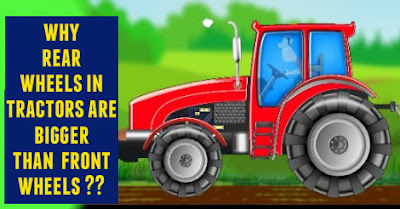
REAR WHEELS IN TRACTOR ARE BIGGER THAN FRONT WHEELS !! WHY??

The word “tractor” is related to words like “traction” and “tractive,” from the Latin word “tractus” meaning drawing (pulling): a tractor is essentially a machine designed to pull things along, usually very slowly and surely.

Reasons for having big wheel at rear and small ones at front:


1.Grip or Traction

Farm tractors spend a lot of their life working in muddy, bumpy fields. If you’ve ever been in car that has driven over a muddy field, you will know that the car slips around on the surface of the mud, or it gets stuck. A large tyre on a tractor has much better grip pads that can ‘bite’ into the ground, as well as a large surface area that distributes weight more evenly which means the traction is a lot better. 
2.Steering
The two smaller wheels at the front have a much better steering radius which means it’s easier to turn sharp corners. This is really important to cover the maximum area of the field while carrying out different jobs like ploughing, sowing and harvesting. Being light weight and small is also really beneficial for ease of control.
3.Visibility
The large rear wheels of the tractor fix the driver’s seat at a higher elevation which ensures good visibility of the nose of the tractor and the corners of the field it ploughs.
4.Cost
Small tyres cost less than larger tyres, and therefore it is much cheaper to replace small tyres that the very expensive big ones! It’s worth noting that because the rear tyres have a much thicker tread that they don’t need to be replaced as often as the front ones.
5.Weight distribution
Having the driving axle higher above the ground means the tractor can pull more weight without the front of the tractor rising up. It works like a lever, where twice the height means twice the maximum pulling force before the tractor tips over.

Lenovo Core i3 6th Gen - (4 GB/1 TB HDD/Windows 10 Home) Ideapad 110 Laptop

Wednesday, 6 December 2017

MONO SHOCK ABSORBER AND DUAL SHOCK ABSORBER : WHICH ONE IS GOOD ?

A motorcycle's suspension serves a dual purpose: contributing to the vehicle's handling and braking, and providing safety and comfort by keeping the vehicle's passengers comfortably isolated from road noise, bumps and vibrations.

The typical motorcycle has a pair of fork tubes for the front suspension, and a swingarm with one or two shock absorbers for the rear suspension.

The hydraulic shock absorbers used on the rear suspensions of motorcycles are essentially the same as those used in other vehicle applications.

There are two broad classification of suspension system :

a.)Dual shock absorber 
b.)Mono shock absorber

Dual shock refers to motorcycles that have two shock absorbers. Generally, this term is used to denote a particular era of motorcycles, and is most frequently used when describing off-road motorcycles.

On a motorcycle with a mono shock absorber rear suspension, a single shock absorber connects the rear swingarm to the motorcycle's frame. Typically this lone shock absorber is in front of the rear wheel, and uses a linkage to connect to the swing arm.

In this video a simplified comparison between both suspension is shown.Check it out :

5 AMAZING FACTS ABOUT TVS APACHE RR310 !!

TVS Motor has finally launched the Apache RR 310. It is the first motorcycle as part of TVS Motor's partnership with BMW Motorrad, co-developed alongside the BMW G310R

Number-5 The Apache RR 310 uses the same liquid-cooled, 313cc single-cylinder engine as the BMW G310R.

Number-4  Outputs are identical as of BMW G310R, at 34PS and 27.5Nm though one major difference is that TVS Motor is using its own custom ECU.

Number-3 The engine cylinder is inclined towards the rear of the motorcycle and has its intake towards the front and the exhaust towards the rear, as opposed to the other way round .

Number-2 The Apache RR 310 uses a 110/70 tyre at the front and a 150/60 tyre at the rear.

Number 1 -The Apache RR310 is also TVS Motor's first ever fully-faired sportsbike.

Interesting,Here is the full specifications of the bike:

Tuesday, 5 December 2017

DIFFERENCE BETWEEN REFRIGERATION AND AIR CONDITIONING EXPLAINED !!

Air conditioners and refrigerators are devices used to keep a space at a colder temperature than its surroundings. The main difference between refrigeration and air conditioning is that refrigeration, in general, refers to any process where thermal energy is taken away from a place and transferred to a place with a higher temperatureAir conditioning is a type of refrigeration where thermal energy is taken away from the air (typically in a room or a vehicle) in order to keep the air cooler. 

What is Refrigeration:

Refrigeration refers to processes that take thermal energy away from a place and gives off that energy to a place with a higher temperature. Naturally, thermal energy flows from a place with a higher temperature to a place with a lower temperature. Therefore, refrigeration runs against the natural heat flow and so it requires work to be done. Refrigerator is a name that we use for devices that are used to keep food at low temperatures. 

What is Air Conditioning:

Air conditioning is a type of refrigeration where thermal energy is taken away from the air in a large space such as a room or a vehicle. Air conditioners are fitted into rooms so that they cool the air inside them. Air conditioners also reduce humidity in rooms, because the water vapour in the room can condense around the colder parts of the air conditioner. The condensed water can be then drained off.

Difference Between Refrigeration and Air Conditioning:

Process

>Refrigeration is a process where thermal energy is transferred from a place with lower temperature to a place with  higher temperature using energy, against he natural flow of heat.
>Air conditioning is a type of refrigeration which is used to cool large volumes inhabited by people.

Functions

>Refrigeration is concerned only with regulating the temperature of a volume of air.
>Air conditioning is concerned with not only maintaining the temperature of a volume of air, but also maintaining he humidity and purity.

Monday, 4 December 2017

TOP 4 REASONS OF ENGINE SEIZE EXPLAINED !!


Engine seize is a condition when engine stops working due to some external or internal cause.In other words,engine seize is when some portion of the engine has lost lubrication and the moving parts have started to abrade each other, either from friction, heat or mechanical failure (example: broken piston ring) to the point that the engine stops turning.Unusual engine noises, low oil pressure, engine overheating, loss of power, misfiring, hard starting and similar driveability and performance complaints can all be indications of problems that need attention.

Causes of Engine Seize :

The major causes of engine failures can be lumped into four basic categories:
  • Overheating (excessive heat)
  • Lubrication (or the lack thereof)
  • Detonation (Spark Knock )(Detonation)
  • Misassembly

1.Overheating:

Overheating can be caused by any number of things. It is often the result of coolant loss or a low coolant level, which is turn may be due to leaks in hoses, the radiator or the engine itself. A weak radiator cap that leaks pressure can allow coolant to escape from the system. Not getting the cooling system completely filled after changing the antifreeze can allow steam pockets to form that make the engine overheat or run hot. An electric cooling fan that fails to come on due to a faulty thermostat, relay, wiring or motor may be an overlooked cause of overheating. So too can a slipping fan clutch. Even a missing fan shroud that reduces the fan's effectiveness may be a contributing factor.

Too much heat in an engine can cause serious problems because heat causes metal to expand. The hotter the engine gets, the tighter clearances become until there are no more clearances left. Overheating can cause valve stems to gall and stick, and pistons to scuff and seize. So if you see either of these conditions when you tear the engine down, it is a pretty good clue that overheating caused the engine to fail.

2.Lubrication:

Every engine needs oil between its moving parts not only to reduce friction but also to carry away heat. Oil is the primary means by which the rod and main bearings are cooled, as well as the pistons. So any reduction in oil flow may cause these parts to run hot, gall and seize.Overhead cam engines are even more vulnerable to oil starvation and low oil pressure problems than pushrod engines because the cam and valvetrain are farther from the pump. When an OHC engine is first started, it takes awhile for oil pressure to reach the cam bearings.
If you suspect engine damage may have been caused by a low oil level, check the dipstick to see how much oil is in the pan. A low oil level may be the result of neglect, oil leakage and/or oil burning.

3.Detonation:

Detonation (Spark Knock ) is a form of abnormal combustion that results from too much heat and pressure in the combustion chamber. The fuel ignites spontaneously causing a sudden rise in cylinder pressure. The result is a sharp hammer-like blow on the piston that produces a metallic knocking or pinging noise. Light detonation is considered normal and should not cause any damage, but heavy or prolonged detonation can crack rings, pound out piston ring grooves, punch holes through the tops of pistons, smash rod bearings and blow head gaskets.

Causes of detonation include excessive compression, elevated engine operating temperature, preignition, overadvanced ignition timing (spark knock), lean fuel mixture, spark plugs that have too hot a heat range for the application, low octane fuel, and even bad driving habits such as lugging the engine excessively with a manual transmission.


4. Misassembly:

You can probably ignore misassembly as a factor in a high mileage engine failure. But in a newly rebuilt engine or a low mileage failure, it should certainly be considered as a possibility. Some common mistakes to look for:
  • Incorrect engine bearing clearances (too tight or too loose). Galling or seizure would tell you bearing clearances were too tight, while fatigue failure would point to excessive clearances.
  • Insufficient Valve-to-Piston Clearance, or Piston-to-Cylinder clearance. Not checking clearances may result in valves hitting pistons (especially with high lift cams or rocker arms) or pistons sticking in cylinders.
  • Misalignment. If the center main bearings show much greater wear than the end bearings, the crankshaft may be bent or the main bores may be misaligned. The underlying condition must be corrected by straightening or replacing the crank and/or align boring the block. The same applies to camshafts and cam bearings (pushrod & OHC).
  • Failure to clean parts properly during engine assembly (not scrubbing out the cylinder bores with soap and water to remove debris and honing residue after they have been bored or honed, for example). Any junk that is left in the engine can scour bearings and wear surfaces.
Sunday, 3 December 2017

STEEL WHEELS ARE USED IN TRUCKS AND BUSES RATHER THAN ALLOY WHEELS.WHY ???


Steel wheels are commonly used in trucks and buses rather than alloy wheels.Although alloy wheels are light in weight but steel wheels are preferred.This Video will give you a clear explanation of reason behind this.

Saturday, 2 December 2017

KNOCKING : REASON AND SOLUTION EXPLAINED !!!

Knocking is a phenomenon of generating unwanted pressure wave which create unpleasant sound and can damage engine wall during combustion in engines. Knocking is largely associated with SI engines. It occurs due to self-ignition of unburned charge into combustion chamber.

When two flame fronts in SI engines collide, they produce an unwanted pressure wave which generates unpleasant sound (knock-knock) and can damage engine wall. Learn more about how Engine knocking works in this article.

Engine Knocking : 

Process:

Knocking is mainly associated with SI engines. It depends on auto ignition quality of fuel. The higher auto ignition temperature causes lower down knocking tendency. To understand whole concept of knocking let’s look out the combustion process.
When the piston reaches at TDC after compression, the spark plug produces spark which ignite the compressed mixture and starts the combustion process. It ignites only those part of mixture witch is in contact with spark plug and generates a main flame front which further ignites the whole mixture. This will generate a high temperature and pressure force inside the cylinder. This burnt part of mixture (combustion products) separate the fresh mixture from spark plug to the other end of the cylinder. As this flame front expands, it compressed the unburned part of the charge. This compression increases the temperature and pressure of unburned part of mixture. If the temperature of this part reaches its auto ignition temperature, it will ignite from other end and a new flame front starts moving towards opposite direction of main flame. When both of these flame fronts collide, it will generate a high pressure wave which produces an unpleasant sound and also damage the cylinder wall.

Factor affecting knocking:

Any factor which tends to decrease auto ignition temperature of charge or tends to ignite the charge except spark plug will affect knocking. Main affecting factor are given below.

Density factor:

The lower dense charge generates low energy and lower rise in temperature thus avoid knocking. If the density of charge decrease, will decreases the knocking tendency. The factors which affect the density of charge are as follows:

Compression Ratio
Increase in compression ratio will increase density of charge thus increase knocking tendency.

Mass of the charge induced:
The mass of charge depends on throttling or supercharging. A reduction in mass of induced charge, reduce the knocking tendency.

Time Factor:

The lower the time available to auto ignition will decrease the knocking tendency. The most affecting time factors are:

Engine Turbulence:
Turbulence reduces the ignition lag or time available for auto ignition. So increase in turbulence will increase the main flame speed and reduce ignition lag, thus reduces knocking tendency.

Spark Plug Location:
To reduce time available for auto ignition, spark plug should locate in order to have minimum flame travel for proper combustion. Generally spark plug located at center to reduce the tendency of knocking.

Engine Size:
As the engine size increase will increase the flame travel thus increases knocking tendency.

Combustion Chamber:
Combustion chamber design play main role in flame travel. The more compact the combustion chamber has minimum flame travel distance thus reduce knocking tendency. Also, the hot spot in combustion chamber should be avoided which can ignite the charge.

Temperature Factor:

Any factor which increases the temperature of inside gases will increase the knocking tendency. These are

Inlet Temperature of Mixture:
More the inlet temperature of mixture, increase tendency of auto ignition thus increase knocking tendency.  

Supercharging:
Supercharging increase both mass and temperature of inside the cylinder thus increases tendency of knocking.

Temperature of Combustion Wall
It will play main role in knocking. The higher the temperature of wall, more chance of auto ignition, thus more chance of knocking.

How to fix knocking:

We have known about knocking phenomenon and factor affecting it. The most methods are used to avoid knock are as follows.

  • Spark plug location should select to minimize the flame travel distance.
  • By proper cooling of Engine wall.
  • Combustion chamber is so design which has less hot spot and higher turbulence.
  • Uses higher auto ignition temperature fuels or add additive in gasoline to increase its knocking temperature.
  • Higher engine speed will reduce knocking.
  • Reduce compression ratio.
  • Reduce supercharging to avoid knocking.